Posts

Showing posts with the label King David

Heroes: Hannah

1 Samuel 1:9-20 We have been looking at some characters from the Old Testament. Some are true heroes of the faith. Others have demonstrated how flawed and sinful humans are. In today’s text, we begin a new chapter in the story of God’s people. They have lived through the times of the judges, times where Israel had no king; everyone did as he saw fit. But the book of 1 Samuel provides a transition to the times of the kings. The immediate context of what we read this morning is this: There was a man named Elkanah who had two wives. Hannah and Peninnah. Hannah was barren. In those days, it was customary for a husband to take a second wife if his first wife could not give him a son/heir. The second wife, Peninnah, had sons, and she tormented Hannah day and night. Hannah was greatly grieved. So at the point of this scripture, the entire family went to the Tabernacle in Shiloh for worship.   Hannah goes to pray. When she goes, we meet Eli, the high priest. Here he sits,...
Heroes? Ruth

Ruth 1:1-17 Who is a hero? We can think of many people who have been heroes in our lives. Usually athletes, freedom fighters, politicians, musicians, talented evangelists… But today’s hero was none of these. She wasn’t rich or famous. She wasn’t politically connected. She wasn’t even a leader. Our hero is a poor widow from an enemy nation. We read the beginning of the Book of Ruth, but here is a summary of what happens next. At the beginning of the book Ruth is living in her home nation, Moab. These were traditionally Israel’s enemies. Ruth’s husband died without giving her a child, and so she lives with her widowed mother-in-law. She could have simply given up. But she did not. There are probably some among us who have gone through significant struggles, much as Ruth did. She suffered loss. She moved far away from her people. She could have defined herself by her failures and her struggles. But she did not allow her past to dictate her future .   God crea...

The Characters of Holy Week: Judas Iscariot

Rarely has there been a clearer villain. He was hand-picked by Jesus as a disciple, one of only twelve to be in Jesus’ inner circle of closest friends. Yet he betrayed Jesus to his death. It can be easy to simply dismiss Judas as the “bad guy” in the story, but as with everyone, his story is much deeper than simply the villain. As I reminded you yesterday, there was a reason Jesus chose Judas to be one of the Twelve. The Twelve regularly went on mission, healing the sick, driving out demons, preaching the Gospel, and there is nothing to indicate that Judas was not a part of this ministry. He was so much a part of the Twelve that John 13:29 indicates that he became their treasurer. Jesus saw him as a follower and a disciple and even among the disciples, Judas had a position of leadership. Unfortunately the Bible does not record Judas doing much more that we can call positive. In John 12:3-5, we see Mary taking a expensive bottle of perfume and anointing Jesus’ feet wit...

Nobody From Nowhere

Blessed are the meek, for they will inherit the earth. Matthew 5:5 What do you think of when you hear the word "meek?" One picture generally comes to my mind and that is a mouse or a mousy person. Meek doesn’t seem like a positive word – people generally don’t want to be described as meek. It carries the connotation of being weak or being a push-over. You can probably think of someone who you might describe as “meek” – and it’s probably not a good thing. Meekness seems to present a contrast with strength. The Greek word that has been translated "meek" or "humble" or "gentle" is πραος pra-os . Praos can also be used three interesting ways: it describes a soothing medicine; it is used by sailors to describe a gentle breeze; and is used by farmers to describe a broken colt. If you think about it this way, medicine can be soothing, but too large of a dose can be devastating. Sailors love a gentle breeze, but a gentle breeze can turn into a...

Jesus the King*

Image
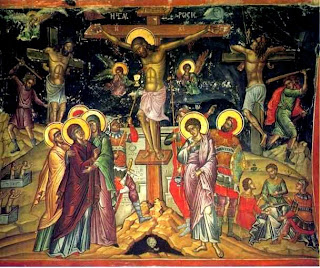
Good Friday Community Service Everything started exactly right. Adam and Eve, in the Garden of Eden, with God as their God and friend. But you know the story; they sinned, and the entire world felt the sting. Separation from God ensued. The God of the Universe pursued His creation, created from nobody a people, a people He would bless to be a blessing to the world. The Lord would be their God and they would be His people. God led Abraham, Isaac, and Jacob. Later, God called Moses to lead His people out of Egyptian captivity – leading Israel in a cloud during the day and a pillar of fire at night. But in the last five chapters of the book of Judges, three times we find the phrase: “in those days Israel had no king.” This is an important designation, because a king was not simply the ruler of his people. In the Ancient Near East, a king didn’t function quite like a king or ruler might function today. It was the universal understanding that the king was not the top dog – the deity w...

Palm Sunday 2013

Matthew 21:1-11 Today is Palm Sunday, and with Palm Sunday, we begin Holy Week, when we recognize the immense sacrifice that Jesus made for us. But Holy Week doesn’t start with resurrection; neither does it start with crucifixion. Holy Week starts with coronation. I will get more into this on Friday at our Lenten service at noon. But as we look at this text, the first thing that stands out to me is that this is a story of obedience . Jesus told the disciples to do something, and instead of asking questions like, “Did you already clear this with the owner of the donkey?” they simply obeyed. I love the verse that says, “The disciples went and did as Jesus had instructed them.” When I’m talking with church people, one thing I hear a lot is “I don’t really know the Bible all that well.” While I agree that our culture is almost entirely biblically illiterate, this is usually a cop-out. Here’s an example: Jesus commanded (not asked) his followers to “ go and make disciples of a...

Saved for Celebration

Psalm 51, part 2: Saved for Celebration Psalm 51:11-15 Last week we ended with the reminder that Christianity isn’t about what we do or how much we have done, because we are all sinners by nature and we can never do enough to somehow appease God or to outweigh our “naughty” list with our “nice.” Christianity is not a religion of “do” – it’s a relationship with Jesus, who has already “done” what we could not do. We are in Psalm 51, the song David wrote after the prophet Nathan confronted him with his sin after he had committed adultery with Bathsheba. As we return to the text, let’s take a moment in prayer. In college, my indoor soccer team was playing for the league championship. Late in the game, the opponents were rushing toward the goal. I was the last defender back. As the guy with the ball passed the ball across the goal toward his wide-open teammate, I stuck my foot out… and the ball bounced off my foot, past our goalkeeper, and into the goal. We lost the champion...

Psalm 51, part 1

It’s not my fault. Someone else is to blame. I would never have done that. I’m the victim here. These are not new claims; in fact, they are the oldest excuses in the book – the Bible, that is. They go all the way back to Genesis, when Satan tempted Adam and Eve and Adam blames Eve and Eve blames the snake… It seems like the same thing gets repeated again and again and again and as we repeat it, we get better at it. We even start to believe it ourselves! The more we tell a story, the truer we think it is. And one story we tell a lot is “it isn’t my fault.” If you don’t know the back story behind Psalm 51, in 2 Samuel 11, King David was at the height of his power, but in the Spring, when kings go to war, David was lollygagging around the palace, spying on a neighbor woman bathing. He acted upon his urges, got her pregnant, tried to cover it up by bringing her husband home from war, but when he wouldn’t sleep with her, David had the husband killed in the war. He felt pretty ...